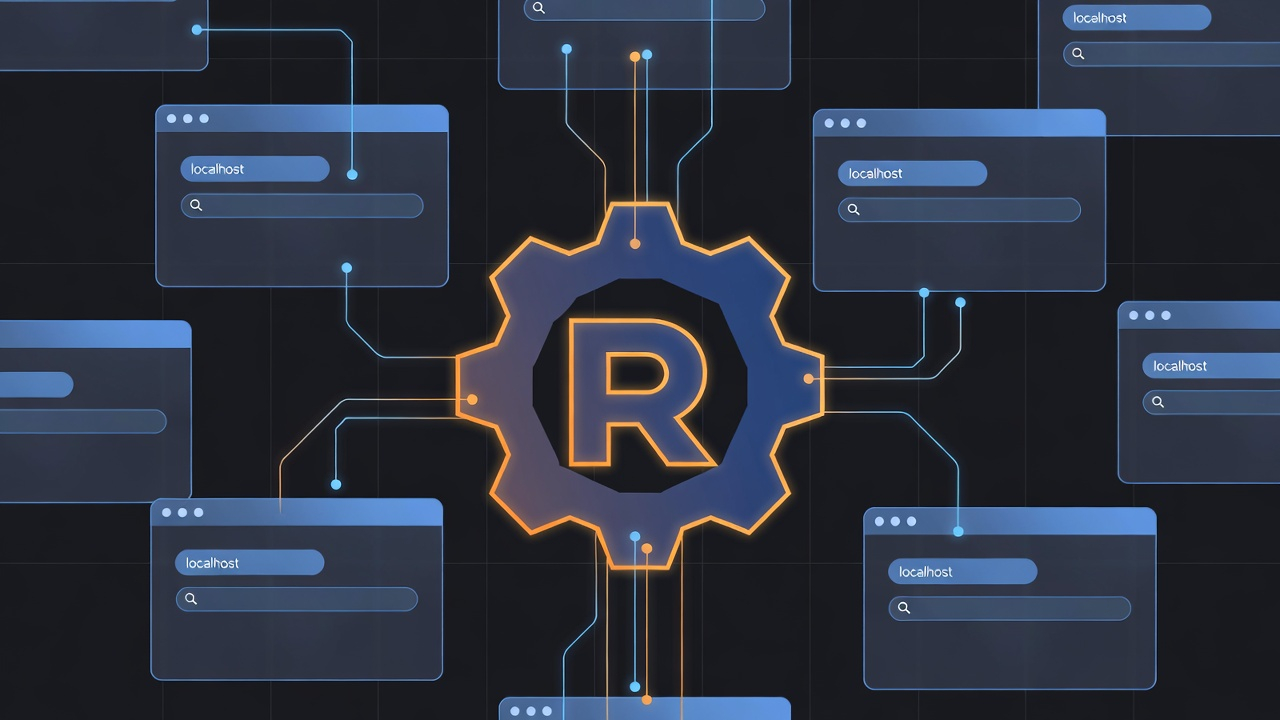
TopGun v0.12 ships a complete Rust server built on axum and tokio, replacing the previous TypeScript implementation. The TypeScript client SDK stays the same — your frontend code doesn’t change.
Try the live demo to see real-time CRDT sync between devices, or read on for the details.
Why Rust
The TypeScript server worked, but we kept hitting the same walls:
- Single-threaded bottleneck. Node.js event loop serializes CPU-bound work like CRDT merges and Merkle tree hashing. Under load, a single expensive merge blocks every connection.
- Memory unpredictability. V8’s garbage collector pauses are invisible until they’re not. For a real-time data grid holding millions of entries in memory, GC spikes translated directly into sync latency spikes.
- No true parallelism. Worker threads help, but they serialize on shared state. Rust gives us lock-free concurrent data structures (DashMap, ArcSwap) without the overhead of message passing between isolates.
Rust solved all three. The new server handles CRDT merges, Merkle tree sync, and full-text search indexing concurrently across all CPU cores, with predictable memory usage and zero GC pauses.
What’s in v0.12
Rust Server
Seven domain services, each independently testable:
| Service | Responsibility |
|---|---|
| CRDT | LWW-Map and OR-Map merge, conflict resolution |
| Sync | Merkle tree delta sync, operation batching |
| Query | Live subscriptions, filtered result sets |
| Search | Full-text search via tantivy |
| Messaging | Pub/sub topics, ephemeral messages |
| Persistence | Embedded redb by default; PostgreSQL optional via sqlx |
| Coordination | Distributed locks (single-node stable; cluster-mode uses partition-routing — Raft in progress), cluster protocol |
The cluster protocol distributes data across 271 partitions with consistent hashing. Nodes join and leave, and the partition map is reassigned on membership change. Note that this reassigns ownership of partitions — live migration of the data already held by a departing node is not yet wired up, so treat cluster mode as single-node-stable with partition-routing rather than a fully elastic, zero-downtime rebalancing cluster.
Client Improvements
The TypeScript client got several reliability fixes:
- Unified reconnection. Previously,
SyncEngineandSingleServerProviderhad independent retry logic with different configs. Now there’s oneBackoffConfigthat flows through the entire stack. - Heartbeat fix. A heartbeat timeout used to permanently kill the connection (calling
close()instead of triggering reconnect). Fixed with a newforceReconnect()path. - Network listener. The client now listens for the browser’s
onlineevent and reconnects immediately when WiFi returns — no waiting for the next backoff timer. - IndexedDB persistence. The demo (and any app using
IDBAdapter) now survives page refreshes. Offline writes persist to IndexedDB and sync when the connection returns.
Live Demo
The Sync Lab demo lets you:
- Latency Race — compare online vs. offline write speed (both sub-millisecond)
- Conflict Arena — disconnect a device, make conflicting edits, reconnect and watch CRDT resolution happen
- Share sessions — open the same session on your phone to see cross-device sync
The demo is also embedded on the TopGun homepage.
Test Coverage
We don’t ship without tests:
- 953 Rust tests — unit + integration across server and core crates
- 2,052 TypeScript tests — client SDK, CRDT core, React hooks, storage adapters
- 55 integration tests — TypeScript client talking to the Rust server over WebSocket
Get Started
npm install @topgunbuild/[email protected] @topgunbuild/[email protected]Start the server:
# Docker
docker compose up --build

# Or directly
cargo run --bin topgun-server --release
Connect from your app:
import { TopGunClient } from '@topgunbuild/client';
import { IDBAdapter } from '@topgunbuild/adapters';

const client = new TopGunClient({
  serverUrl: 'ws://localhost:8080',
  storage: new IDBAdapter(),
});

client.start();

const todos = client.getMap('todos');
todos.set('todo-1', { text: 'Ship it', done: true });
Full docs at topgun.build/docs.
What’s Next
- Schema validation — define and enforce record shapes
- SQL queries — DataFusion-powered SQL over CRDT data, as an opt-in, compile-time feature flag (off by default to keep the standard build lean)
- WASM client — same Rust CRDT engine running in the browser
- Multi-tenancy — isolated namespaces on a shared cluster
Follow the project on GitHub.